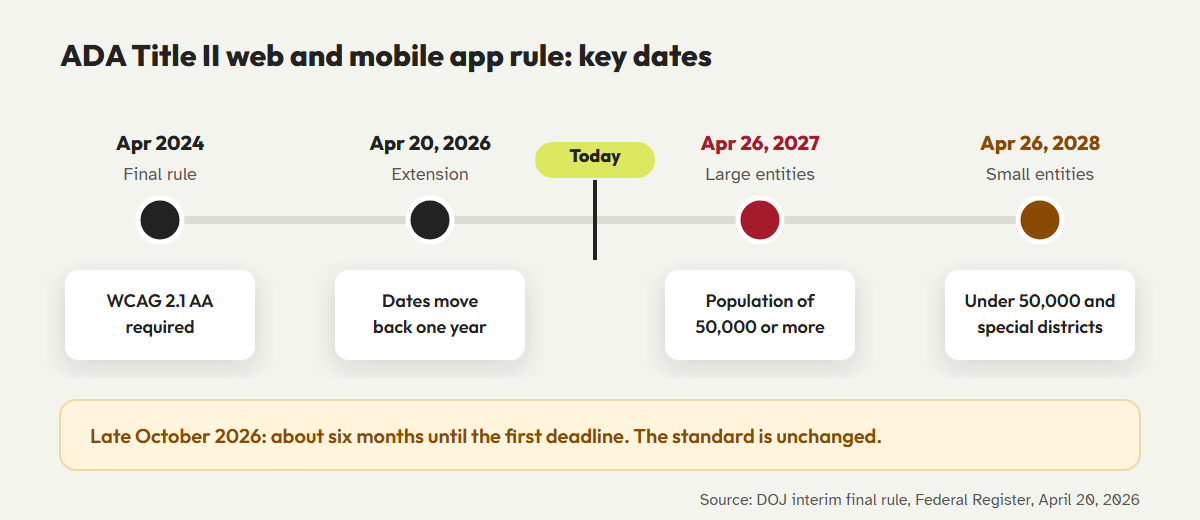
In April 2026, the U.S. Department of Justice gave state and local governments more time to make their websites and mobile apps accessible. Many public sector teams took that as permission to slow down. It wasn't. The extension changed the dates and nothing else. The technical standard, the scope and the exceptions are the same as in the 2024 rule. For the largest public entities, the new deadline of April 26, 2027 is now less than six months away.
This guide explains the ADA Title II 2027 deadline, who it applies to, why it reaches far beyond your home page, and gives a practical winter roadmap for WCAG 2.1 AA public sector compliance. It's written for cities, counties, school districts, public libraries, public hospitals and clinics, transit agencies and utilities, and for the vendors who build their digital services.
Key takeaways
- Public entities serving 50,000 or more people must comply by April 26, 2027. Smaller entities and special district governments have until April 26, 2028.
- The standard is still WCAG 2.1 Level AA for web content and mobile apps.
- The rule covers PDFs, forms, apps and content provided through vendors, not just the website.
- Accessibility is moving from "best effort" to a specific, testable standard. Use this winter to inventory, prioritize and fix procurement.
In this guide
The new ADA Title II deadlines
The DOJ's final rule on web and mobile app accessibility under Title II of the Americans with Disabilities Act was published in April 2024. On April 20, 2026, the DOJ published an interim final rule that pushed each compliance date back by one year. It cited resource constraints, staffing limits and slower-than-expected progress on technical solutions.
| Public entity | Original date | New date |
|---|---|---|
| Total population of 50,000 or more | April 24, 2026 | April 26, 2027 |
| Total population under 50,000 | April 26, 2027 | April 26, 2028 |
| Special district governments (for example, some library, water, transit and hospital districts) | April 26, 2027 | April 26, 2028 |
Population is measured for the whole jurisdiction the entity belongs to, not the number of people who use a particular service. A small public library run by a county of 200,000 people falls under the county's 2027 date. A public university or hospital that is part of a state government falls under the state's date. If you aren't sure which bucket you're in, ask your legal counsel now rather than next spring.
Smaller entities shouldn't wait for 2028. Title II's general duty not to discriminate already applies today, and the DOJ has said that obligation continues during the extension. A 2028 compliance date doesn't stop someone from filing a complaint about an inaccessible utility portal this winter.
From "best effort" to a technical standard
Before this rule, Title II required public entities to provide equal access to their services, but it didn't name a specific technical standard for the web. That left room for "we're doing our best" arguments. The rule ends that. It names WCAG 2.1 Level AA as the benchmark, which means compliance can be tested, measured and documented, and failures can be pointed to criterion by criterion.
That shift matters because the wider litigation climate is heating up. UsableNet's 2026 midyear report projects around 6,000 U.S. digital accessibility lawsuits this year, which would be a record. Most of those target businesses, not governments, but a clear technical standard makes it much easier to evaluate a public entity's website, too. Complaints to the DOJ, investigations and lawsuits can all now point to a published benchmark.
It's not just your website
The rule covers web content and mobile apps that a public entity provides or makes available, directly or through contractual, licensing or other arrangements. That last phrase is the one that catches teams out. If a resident uses it to access your services, it's probably in scope, even if a vendor built it.
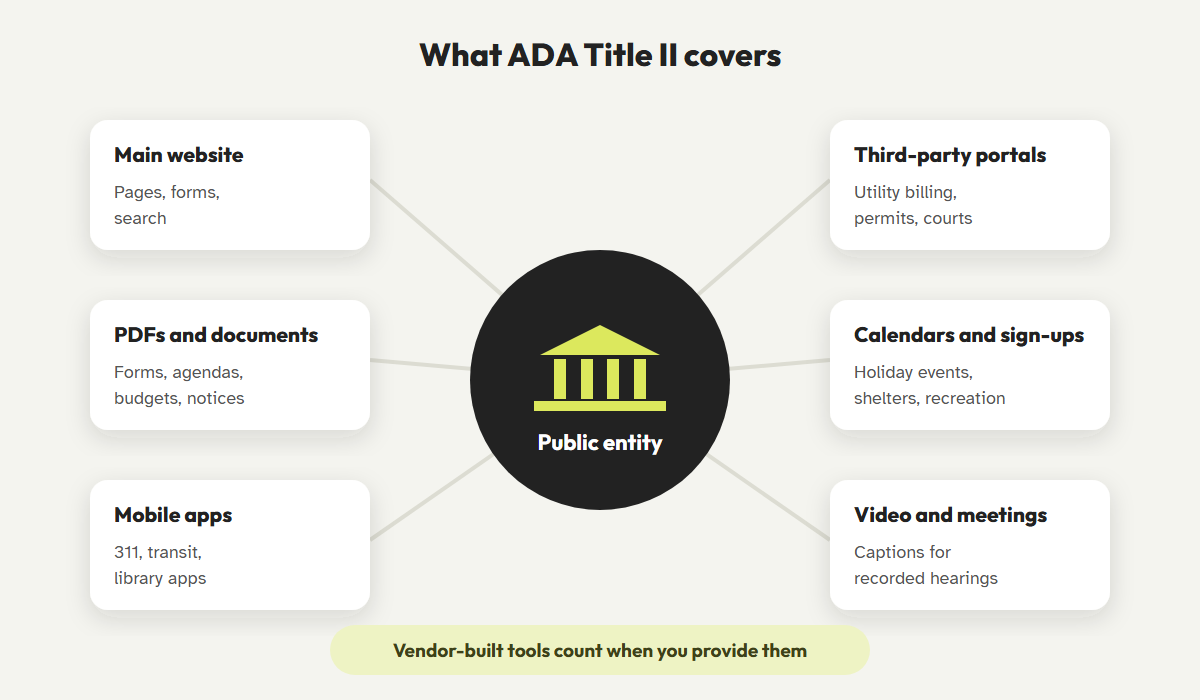
- Documents. PDFs, Word files and spreadsheets on your site, such as permit applications, council agendas, budgets and public notices. For many entities, documents are the largest remediation job.
- Mobile apps. Transit trackers, 311 reporting apps, library apps and parks booking apps must also meet WCAG 2.1 AA.
- Third-party portals. Utility bill payment, court records, permitting, recreation registration, job applications and patient portals at public health systems.
- Seasonal tools. Holiday event calendars, winter shelter sign-ups, snow emergency alerts and toy drive registrations are often bolted on quickly with a free plugin or form builder, and they're exactly what residents need to use.
- Media. Recorded meetings, videos and live-streamed hearings need captions, and video-only content needs alternatives.
What the exceptions do and don't cover
The rule has a handful of exceptions, and they're narrower than many teams hope. In summary:
| Exception | Covers | Doesn't cover |
|---|---|---|
| Archived web content | Old content kept only for reference, in a clearly marked archive, and not changed since archiving. | Anything people still need to use a current service. |
| Preexisting documents | PDFs and documents posted before the compliance date. | Documents still used to apply for, access or take part in a service, such as a current permit form. |
| Third-party posted content | Content posted by members of the public, such as comments. | Content a vendor posts or builds on your behalf. |
| Individualized password-protected documents | Documents about a specific person, such as a single utility bill. | The portal itself, which must still be accessible. Individual documents must be made accessible on request. |
| Preexisting social media posts | Posts made before the compliance date. | New posts after the date. |
The rule also allows limited defenses where full compliance would result in a fundamental alteration or undue financial and administrative burden. These are high bars that require a documented decision. They're not a general opt-out.
A winter roadmap for public entities
Whether your date is 2027 or 2028, the next five months are the best time to get organized. Budget cycles, procurement and staff training all take longer than the technical fixes.
- November: inventory everything.List your websites, subdomains, apps, document libraries, vendor portals and embedded tools. Note who owns each and which contract covers it.
- December: scan and sample.Run an automated scan across your sites to find template-level problems. Then manually test your highest-traffic services with a keyboard and a screen reader.
- January: prioritize by service.Rank fixes by how essential the service is (paying a bill, applying for benefits, reporting an emergency) and how many people use it. Fix templates before individual pages.
- February: fix procurement.Add WCAG 2.1 AA requirements, an accessibility conformance report and a remediation clause to every new and renewing contract. Ask current vendors for a roadmap.
- March and April: remediate and train.Fix high-priority issues, set up an accessible document workflow so new PDFs are born accessible, and train content editors.
- Ongoing: publish and monitor.Publish an accessibility statement with a way to report barriers, schedule regular scans and re-test after every redesign or new vendor.
Tackle documents strategically. Start by removing outdated files and moving archived ones into a clearly labeled archive. Convert forms people still use into accessible HTML forms. Then fix the PDFs that remain, starting with the most downloaded.
Get a clear picture before the deadline
CoreA11y scans WordPress sites against WCAG criteria, fixes common issues at the source and guides your team through a documented manual review, so you can show progress to leadership and residents.
Start your public sector auditWhy manual testing mattersFrequently asked questions
When is the ADA Title II web accessibility deadline?
April 26, 2027 for state and local government entities with a total population of 50,000 or more. April 26, 2028 for entities under 50,000 and for special district governments. These dates come from the DOJ's interim final rule published April 20, 2026.
Did the extension change the WCAG version?
No. The rule still requires WCAG 2.1 Level AA. Building to WCAG 2.2 AA is a sensible way to future-proof, because it includes all of 2.1 AA.
Are public hospitals and libraries covered?
Yes, if they're operated by a state or local government or a special district. Their websites, patient or patron portals, apps and documents are all in scope. Public health providers may also have separate obligations under Section 504.
Is a vendor's portal our responsibility?
Generally, yes. The rule covers content you provide through contractual, licensing or other arrangements. Put accessibility requirements in contracts and ask vendors for evidence, such as an accessibility conformance report.
Could the rule change again?
The DOJ took comments on the interim final rule and has signaled it may consider further rulemaking. Until anything changes, plan for the current dates and standard.
This article is general information, not legal advice. Check the Federal Register text and consult your counsel about how the rule applies to your organization.
References
- U.S. Department of Justice, "Extension of Compliance Dates for Nondiscrimination on the Basis of Disability; Accessibility of Web Information and Services of State and Local Government Entities," Federal Register, April 20, 2026. federalregister.gov
- ADA.gov, "Fact Sheet: New Rule on the Accessibility of Web Content and Mobile Apps Provided by State and Local Governments." ada.gov
- UNC School of Government, "Deadlines to Comply with ADA Web Accessibility Requirements Extended by One Year," 2026. sog.unc.edu
- Level Access, "The ADA Title II and Section 504 Extensions: What They Don't Change," May 2026. levelaccess.com
- UsableNet, "Digital Accessibility Lawsuits in 2026: Five Trends Companies Should Know," July 2026. blog.usablenet.com
- W3C, "Web Content Accessibility Guidelines (WCAG) 2.1." w3.org/TR/WCAG21